
Meet a researcher: Dr Nicholas Anthony
5 min read 23 October 2025
In cancer research, the biggest discoveries often start at the smallest levels. Many of the groundbreaking new insights that help to improve cancer treatment are found at the end of a microscope. As the technology to study cancer at the smallest levels continues to advance, it is essential that researchers are equipped with the knowledge and tools to continue making these discoveries. This is where Dr Nicholas Anthony and his team come in.
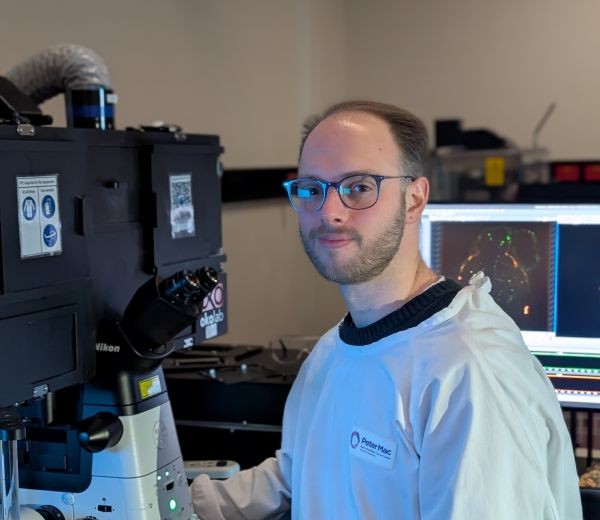
Dr Anthony manages the Centre for Advanced Histology and Microscopy (CAHM), a core facility of Peter Mac. Peter Mac’s core research facilities are central shared labs that provide cutting edge tools, technologies and specialist expertise to all researchers. All core facilities are located onsite at Peter Mac, meaning that researchers can collaborate and deliver study results swiftly and efficiently. This is a unique feature of Peter Mac that gives our research a distinct edge.
The generosity of Foundation donors is essential in supporting our incredible core facilities teams, allowing them to purchase the equipment needed to accelerate vital research discoveries that save lives.
As a core facility, CAHM supports researchers in looking closely at biological samples at the cellular level using state-of-the-art technology, helping them to observe live specimens in exquisite detail.
“At Peter Mac I train researchers on how to use our equipment, advise them on what techniques would help in their research questions, and help introduce more advanced modern techniques to get the most out of our precious samples,” says Dr Anthony.
Dr Anthony’s career journey began when he studied nanotechnology at university – the study of matter at a very small scale. Describing nanotechnology as “a mixture of biology, chemistry and physics”, he learned that physics resonated with him the most.
“After a summer internship as an industrial chemist, I decided that chemistry wasn’t for me, and I became more interested in physics.”
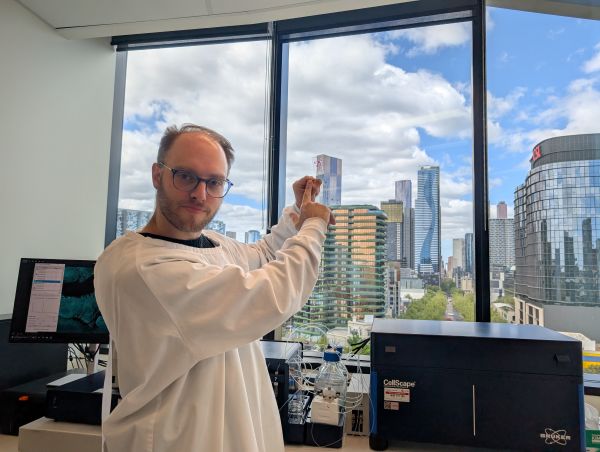
Dr Anthony’s PhD in physics involved building a new type of microscope to help researchers image their biological samples without needing to modify them first. Building this microscope involved a lot of time in the lab assembling different lenses, filters, and cameras.
“It was like a Lego kit,” he explains.
Upon finishing his PhD, Dr Anthony continued to work on developing and modifying microscopes. He joined a large microscopy lab in Italy as a Postdoctoral Researcher, before going on to manage a microscopy facility at King’s College London. Working in this facility sparked an appreciation for the role of core facilities and helping researchers to achieve their scientific mission.
“This was a really fun job as I got to use my expertise to modify microscopes and enable some really unique projects. But more importantly, it really made me enjoy research! I get so much enjoyment and satisfaction from helping others solve their problems and joining their journey from hypothesis to result.”
Dr Anthony was excited to bring this experience back to Melbourne and soon found his job managing CAHM at Peter Mac. Empowering researchers to make pivotal discoveries to improve the future of cancer has been a hugely rewarding part of his role.
“It’s especially rewarding to see the discoveries researchers work hard on turned into real world treatments, and advance our knowledge of cancer,” says Dr Anthony.
“For example, our researchers grow ‘organoids’ – tiny, lifelike mini-organs – in the lab. Seeing inside these delicate structures is a major hurdle, so part of my role is to provide the cutting-edge technology to solve it.
“Using a new and highly specialised microscope, we scan the organoid to create a 3D movie, which allows us to watch how cancer cells interact with healthy tissue in real-time. This is a game-changer because it allows us to test the effectiveness of new drugs in a setting that is much closer to a real patient, helping to accelerate the journey from the lab to the clinic.”
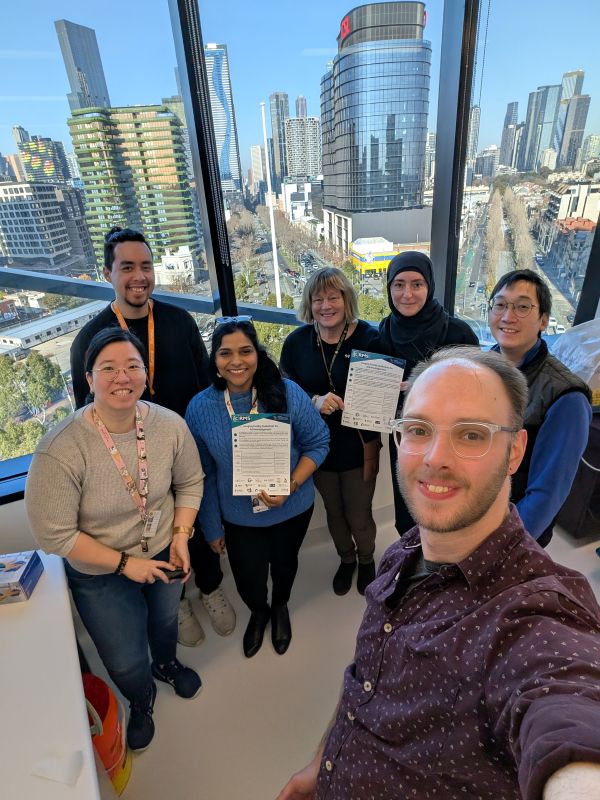
Emphasising the importance of Foundation funding to CAHM, Dr Anthony says:
“I’ve greatly enjoyed working with the Foundation to support cancer research at Peter Mac. Through the Foundation I’ve had the chance to meet many wonderful donors, and supporters, who visit our labs and have many thought-provoking questions about what we do, and how it impacts them and their loved ones.
“Without the Foundation, we would only be able to achieve a fraction of what we do. The funding provided by the Foundation is pivotal in helping us achieve our research goals by hiring talented people and providing access to some of the best equipment in Australia.”
@Follow us on Instagram (@SupportPeterMac)